
Earth Venture Orbital 1
Earth Venture Orbital 1 (EVO-1)
Earth Venture Orbital 1 (EVO-1)
Questions and Answers
Last updated 7/31/2026 -- Click here for downloadable version
All recent changes are in red text.
Categories of Questions
- AO Process (A)
- Cost (C)
- Schedule (H)
- Mission Concept (M)
- Orbit and Access to Space (O)
- Partnerships, Contracts, and Agreements (P)
- Science (S)
| Change Log | ||
|---|---|---|
| Rev. | Date | Description of Changes |
| 00 | 05/13/26 | First set of Q&A in response to 03/24/2026 Community Announcement: A-1, C-1, C-2, C-3, H-1, H-2, M-1, M-2, M-3, M-4, O-1, O-2, O-3, P-1, P-2, P-3, P-4, P-5, S-1, S-2, S-3, S-4, S-5. |
| 01 | 07/31/26 | Amended C-1; Combined S-3, S-4, S-5 into S-3 and provided updated response |
AO Process (A)
-
AO preparation requires significant time and resources. So that proposing institutions may appropriately direct resources, we request a second community announcement as soon as possible that provides additional details on the association between cost range and mission type as well as the parameters and limitations of this AO.
NASA fully appreciates the resources required to prepare for and propose to an AO. As such, NASA intends to provide continual updates on the EVO-1 website and will also consider releasing a second community announcement in advance of the release of the draft AO. Further, NASA invites continual community feedback to help shape this AO and NASA intends to provide continued feedback and opportunities for discussion.
Cost (C)
-
Regarding the Cost Cap:
Can a mission concept be proposed with architecture/implementation options that span the $35M-$115M cost range, or will there be a single fixed cost cap value for EVO missions?
NASA should provide specific cost caps based on implementation categories (e.g., Instrument-only vs. Full Mission). A single range makes it difficult for university-led teams to right-size their science objectives.
Will there be distinct categories of size and scale for mission scope (a)-(c)? Will they have different explicit cost caps?
NASA intends to solicit investigations in three categories as announced: (a) space-based instruments for integration on a NASA-provided platform/launch vehicle; (b) instrument(s) and spacecraft (i.e., complete observatory), including CubeSats, for integration on a NASA-provided launch vehicle; or (c) complete missions where the PI provides instrument(s), spacecraft, and launch vehicle.
NASA intends to explicitly state a distinct cost cap for each category (a), (b), and (c) as well as necessary parameters/structure in the AO to ensure clarity for all proposers. NASA does not intend to allow for proposers to propose a unique cost cap outside of those provided parameters. Proposers will be responsible for defining and proposing missions that can be successfully achieved within those cost caps. Further, NASA intends to require PIs to propose to only one category.
NASA intends to provide proposers with the flexibility to select one of three mission structures that best accommodates their mission concepts, partnerships, allocation of responsibilities, and approach to access to space. Table 1 summarizes the parameters associated with each mission structure, including expected key milestones and Cost Cap guidance for each category. NASA anticipates requiring proposed investigations that have a prime mission operation duration of at least one year.
Proposers in categories (a) and (b) must demonstrate accommodability of the proposed mission concept on NASA-provided platform and/or launch vehicles, by leveraging the offerings available through: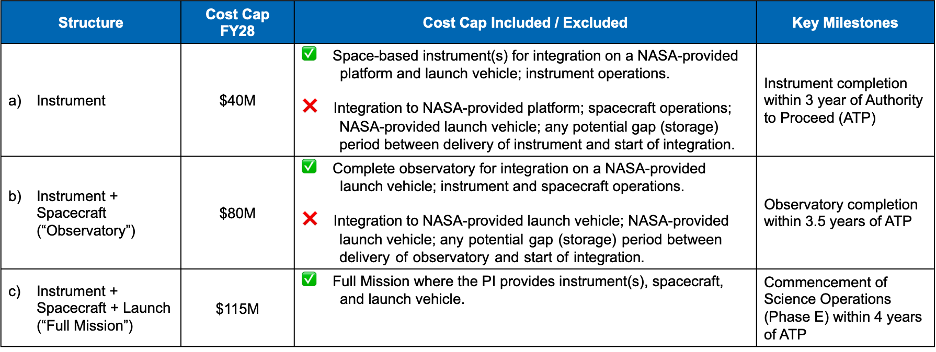 Table 1. Eligible mission structures, Cost Cap, and key milestones dates
- NASA Flight Opportunities Program (FOP): https://www.nasa.gov/stmd-flight-opportunities/; and
- Launch Services Program Venture-Class Acquisition of Dedicated and Rideshare (LSP VADR): https://www.nasa.gov/vadr-venture-class-acquisition-of-dedicated-and-rideshare-launch-services/.
-
Is the assumption that one mission up to $115M will be selected OR multiple (for example, 3 missions at $35M) will be selected sharing the same cost cap?
NASA may select one or more investigations based on the established cost cap values and funding availability. Based on current budgetary parameters, no more than one complete mission at a $115M cost cap can be supported. Note that NASA will also assess the feasibility and cost of securing an appropriate spacecraft and/or launch arrangement for any proposed missions that require NASA to provide those resources; the outcome of this assessment will also impact the number of selections that can be made within the available budget.
-
Previous Earth Venture Mission and Instrument solicitations have included a requirement similar to the below. Implementation of this requirement has previously caused confusion and imposed a burden on centers that effectively changes the available cost cap of the proposed mission for the centers. It is recommended that this requirement not be included in the upcoming EVO solicitation.
NASA Center Management and Operations (CM&O) Requirement (from EVM-3):
“Estimated NASA Center Management and Operations (CM&O) overhead costs must also be included within the PIMMC, to enable a level playing field for all proposers. Per NASA HQ policy guidance signed in June 2010 by the Associate Administrator for the Mission Support Directorate and by the Agency Chief Financial Officer, all NASA Centers are to use an identical CM&O burden rate of $51K (Fiscal Year 2022) per “equivalent head.” As per Agency policy, this rate must be applied as a “cost per equivalent head” to all Civil Servant Full-Time Equivalents (FTEs) plus on or near-site contractor Work-Year Equivalents (WYEs) associated with the proposal. The estimated FTEs and WYEs per Fiscal Year, and the resulting CM&O burden, must be identified in a separate table within the budget justification section of the proposal. The CM&O rate will not change from year to year in Fiscal Year (FY) 2020 dollars, but in Real Year (RY) terms, it will inflate.”
NASA appreciates this feedback. AO requirements are still being refined and will be articulated no later than release of the Draft AO.
Schedule (H)
-
What is the anticipated release of the Draft AO (i.e. when in Q3 of CY26)?
As of May 2026, NASA intends for the Draft AO to be released by the end of Q3 (i.e., September 2026), with no additional schedule fidelity available at this time.
-
In addition to the 3–4 year launch target, will EVO-1 evaluation credit completion of pre-launch science-readiness milestones — OSSEs, Level-2 algorithm maturity, and data-assimilation operator integration — that reduce the interval between first light and validated science products?
As stated in the March 24, 2026, Community Announcement, NASA is focused on the PI’s ability to reduce the time-to-science and demonstration of approaches to do so in their proposal submissions. Further, NASA intends for the evaluation factors to include a focus on the PI’s ability to reduce the time-to-science.
Mission Concept (M)
-
Regarding spacecraft/platforms and launch opportunities:
Will proposers of a space-based instrument for integration need to identify the platform to be hosted on? Will the cost of integration of a space-based instrument to the host platform be included in the solicited cost cap?
Will proposers need to identify the intended NASA or private launch opportunity? If so, the proposed PIMMC ($35M – $115M) is insufficient to include launch costs.
Will NASA be giving a short list of buses for option (a) [space-based instruments for integration on a NASA-provided platform/launch vehicle]?
Each team will be designing to cost, so we need to know of any instrument / platform accommodation constraints or accommodation cost boxes. In addition, we would like to know if there are any regulations or restrictions for a PI who chooses to provide their own launch.
For proposed space-based instruments in category (a) that require integration on a NASA-provided platform/launch vehicle, NASA does not intend to provide a short list of platforms/launch vehicles since that scope will be the responsibility of NASA and will be handled as a competitive procurement under NASA’s Flight Opportunities Program (FOP) (https://www.nasa.gov/stmd-flight-opportunities/). In this category, the intent is that the cost cap includes instrument operations but excludes the cost of the NASA-provided platform/launch vehicle (including spacecraft operations), integration of the instrument to the NASA-selected platform/launch vehicle, and any potential gap (storage) period between the delivery of the completed instrument and the start of integration.
Similarly, for proposed observatories in category (b) that require integration on a NASA-provided launch vehicle, NASA does not intend to provide a short list of launch vehicles since that scope will be the responsibility of NASA and will be handled as a competitive procurement under NASA’s Launch Services Program Venture-Class Acquisition of Dedicated and Rideshare (VADR) (https://www.nasa.gov/vadr-venture-class-acquisition-of-dedicated-and-rideshare-launch-services/). In this category, the intent is that the cost cap includes instrument and spacecraft operations but excludes the costs for the NASA-provided launch services, integration of the observatory to the launch vehicle, and any potential gap (storage) period between the delivery of the completed observatory and the start of integration.
For complete missions in category (c), all activities and costs are the responsibility of the PI, including compliance with all laws and regulations governing launch-related activities. The PI will need to identify the intended spacecraft, launch vehicle, or other opportunity in the proposal so the entire proposed mission can be evaluated.
For proposals in categories (a) and (b), it is incumbent upon the proposers to perform the necessary due diligence on available offerings under the applicable FOP or VADR program to ensure their proposed concept/instrument can be accommodated on more than one offering. NASA intends to require proposers to provide a summary of their due diligence (but not an identification of a specific solution) with their proposal submissions as NASA intends to evaluate “accommodability” of the proposed mission during the evaluation process.
-
Can proposed mission concepts that include a small constellation of platforms and/or staggered launches (i.e. one launch per year) be considered to provide better global coverage and/or longer-term records?
As noted in the March 24, 2026, Community Announcement, NASA is open to novel and innovative approaches that meet the cost cap(s) that will be stated in the AO for categories a, b, and c. Also note answer to question C-2.
-
For investigations whose primary deliverable is a science data record rather than a hardware asset, will the solicitation define ‘complete mission’ in terms of a delivered, open Level-2 science data record meeting specified quality thresholds, accompanied by a defined validation period?
NASA expects proposed investigations to include investments in new spaceflight hardware, as well as the execution of a focused science investigation and the production of supporting data. Accordingly, a “complete mission” encompasses the successful development and deployment of relevant instrumentation, the conduct of the science investigation, and the delivery of validated, openly-available, science-ready data.
-
Does EVO-1 intend to accommodate investigations where NASA funding is directed at NRE activities — instrument maturation, calibration infrastructure, pre-launch OSSE campaigns, on-orbit commissioning — within a larger, privately-funded multi-instrument constellation program, with science-quality data delivery as the primary deliverable? If so, will the solicitation provide evaluation guidance for such proposals relative to traditional instrument-build and data-buy approaches, including applicable Class D / SPD-48 tailoring?
As noted in the March 24, 2026, Community Announcement, NASA is open to novel and innovative approaches to achieve the desired science output and understands that such an approach may not align with historical precedent/approaches. NASA is also open to further tailoring of the SPD-48 Class D Policy and will assess any proposed tailoring during the evaluation phase.
Orbit and Access to Space (O)
-
Can PIs propose to use the ISS as a platform for instruments/experiments under the forthcoming EVO-1 call (either external mount locations, or using an internal facility like the Window Observational Research Facility (WORF))? If the answer is yes, would the PI have to budget for transport using a commercial vehicle, as they would under the Flight Opportunities program?
No, NASA does not anticipate allowing for use of the ISS under this EVO-1 effort based on the current expected lifetime of the ISS and anticipated launch for EVO-1 of no earlier than 4Q CY2030.
-
Is GEO and MEO completely off the table or is it an option for (c) [complete missions where the PI provides instrument(s), spacecraft, and launch vehicle] if can fit in the cost cap?
For this AO, NASA intends to limit missions to low earth orbit (LEO) only.
-
Will there be any restrictions on orbit options, orbit-insertion altitude limits, or the use of propulsion to maintain orbit for the EVO missions? Might this AO have other orbit-selection requirements, such as about materials selection as related to re-entry requirements and any end-of-life or mission-duration requirements?
NASA does not intend to restrict orbital parameters other than the requirement that all mission be to LEO and comply with all applicable laws and regulations regarding re-entry and end-of-life requirements. It is incumbent upon the proposers to perform the necessary due diligence on available spacecraft/platforms and launch vehicle capabilities to ensure their mission concept is feasible and realistic.
Partnerships, Contracts, and Agreements (P)
-
Will inter-agency agreements be allowed for EVO missions? If inter-agency agreements are allowed, will there be a waiting period before they can be enacted and funds exchanged?
NASA does not intend to prohibit Interagency Agreements with other U.S. Government entities. However, proposers should be aware that the process to enact these agreements can take 6+ months and that process will not begin until after a selection is made. Therefore, proposers need to account for this process/timeline in their proposed schedule/approach.
-
Regarding contributions:
How does the solicitation intend the PIMMC to account for leveraged private co-investment — whether through guidance on proposal cost accounting, tailoring under NPR 7120.5 Class D / SPD-48, or architecture-sensitive evaluation — so that commercial-constellation co-investment approaches can be compared on a consistent basis with traditional instrument-build and complete-observatory architectures?
In the past there have been foreign contribution limits of ~25% of NASA cost. Will this still be in place or can it be comparable to the NASA cost commitment?
Similar to previous Earth Venture AOs, NASA intends to allow contributions from both U.S. and non-U.S. sources. These contributions may include, but are not limited to, labor, services, computing resources, spacecraft, and launch vehicle. Contributions of non-U.S. nuclear power sources are prohibited. Bilateral participation, collaboration, or coordination with China or any Chinese-owned company or entity, whether funded or performed under a no-exchange-of-funds arrangement, are also prohibited.
Historically, NASA EV AOs have limited the sum of contributions of any kind to the entirety of the investigation in an amount that could not exceed one-third (1/3) of the proposed cost cap. This was done to help ensure a preponderance of NASA interest in the mission, as well as to ensure that missions of roughly comparable scope are proposed for purposes of equitable competition. However, for this EVO-1 AO, NASA is revisiting this prior approach and intends to provide updates no later than with the issuance of the Draft AO.
-
Regarding post-prime mission partnerships:
The requirement for identifying post-prime, non-NASA partnerships requirement should be included as a non-rated portion of the proposal. There is insufficient time to adequately develop partnership agreements prior to this solicitation. Responding to this requirement should not require a specific partnership with projected costs. Rather, it should involve PIs identifying a potential commercial or philanthropic sector and a plan of approach for future partnerships. Will the ability to commercialize the proposed science, and thus find a partner to take over the post-prime mission, be a requirement? Most of the Earth Science Division’s portfolio is not easily commercialized.
The community announcement states "NASA also intends to require the PI to identify potential non- NASA funded partnerships for continued operations and data collection/processing after the prime mission.” Could you clarify what the expectation of the level of commitment from a partner (i.e. Full commitment, Letter of intent, etc)?
For EVO-1 investigations where the PI organization operates a multi-instrument commercial constellation with executed institutional customer contracts, diversified private funding, and hardware commitments extending beyond the prime mission, may post-prime continuity be satisfied through a combination of (a) executed commercial agreements, (b) a contractual commitment to continue NASA-designated science-product delivery for a defined post-prime window, and (c) documented capital commitments? If a specific non-NASA data-acquisition agreement is required instead, will the solicitation clarify the expected form?
NASA appreciates this feedback and is continuing to discuss and consider varying approaches and requirements related to post-prime mission partnerships. The outcome of this internal discussion will be communicated no later than release of the Draft AO.
-
For EVO-1 investigations where the PI is employed by a commercial operator that also operates the constellation providing investigation data, what teaming and conflict-of-interest guidance will the solicitation provide — including expectations around Co-I composition and government / university partnerships?
Apart from organizations listed in the AO that provide evaluation or assessment support, NASA does not intend to place any limits on the PIs or Co-Is association with or employment by any given entity (e.g., the PI could be employed by an academic institution, commercial company, Government entity, etc.), nor does NASA intend to require the PIs and Co-Is to come from any specific entity. The overall approach and structure will be at the discretion of the proposer.
NASA will perform its own due diligence to ensure all conflicts of interest issues are appropriately managed for members of the evaluation and selection team based on those entities who propose in response to the AO for this effort. Complete details of this due diligence will be provided in the AO Evaluation Plan as it has been for previous AOs.
-
Could the team consist of University, FFRDC, NASA Centers, and private companies, small or large?
Prospective investigators from any category of organizations or institutions, U.S. or non-U.S. with some restrictions as specified below, are welcome to respond to this solicitation. Specific categories of organizations and institutions that are welcome to respond include, but are not limited to, educational, industrial, and not-for-profit organizations, Federally Funded Research and Development Centers (FFRDCs), University Affiliated Research Centers (UARCs), all NASA Centers, and other Government agencies. However, proposals must not include bilateral participation, collaboration, or coordination with China or any Chinese-owned company or entity, whether funded or performed under a no-exchange-of-funds arrangement.
Science (S)
-
Will EVO-1 clarify the SPD-41A boundary for instruments whose raw data stream serves both an EVO-1 science investigation and pre-existing commercial data obligations — specifically, whether delivery of NASA-designated L1b / L2 investigation products under NASA-specified EULAs satisfies SPD-41A while commercial rights to the broader raw data stream are preserved? If a different structure is required, will the solicitation describe it?
NASA will follow established requirements in which a commercial provider retains commercial rights to the underlying pre-existing raw data streams, as long as NASA receives processed (e.g., L1b/L2), validated data products that are made available under existing end-user agreements including open access.
-
Is Earth Action / Applications / Societal Benefit going to be a selection criterion?
Proposed science investigations are expected to align with NASA’s Earth Science to Action strategy. While the formal evaluation criteria are still being refined and will be articulated in the Draft AO, alignment with the Earth Science strategy, including the delivery of societally relevant applications alongside breakthrough science, is an important programmatic consideration.
-
Will the EVO-1 solicitation consider including investigations of extreme event dynamics in the Earth system, particularly those involving episodic energy release processes such as earthquakes, especially when studied in connection with external (heliophysical or planetary) forcing.
NASA is continuing to assess the overall science focus for this EVO-1 AO. NASA intends to communicate this information no later than release of the draft AO.
-
It would help us to know scientific constraints such as targeted observables and objectives, or confirmation that all of the National Academies Decadal Survey observables will be considered in the announced AO.
NASA is continuing to assess the overall science focus for this EVO-1 AO. NASA intends to communicate this information no later than release of the draft AO.
-
Is there a desired ESD portfolio balance on mission scope (a)-(c) for EVO, and will it be articulated in the draft AO?
NASA is continuing to assess the overall science focus for this EVO-1 AO. NASA intends to communicate this information no later than release of the draft AO.
-
Regarding the science focus for EVO-1:
EVO-1 prioritizes proposals for novel observing systems that enable first-of-their-kind measurements not currently available from space. The program emphasizes complementarity rather than duplication of existing or planned observations by NASA, or by international or commercial partners, particularly where those capabilities already meet the measurement need.- Will the EVO-1 solicitation consider including investigations of extreme event dynamics in the Earth system, particularly those involving episodic energy release processes such as earthquakes, especially when studied in connection with external (heliophysical or planetary) forcing.
- It would help us to know scientific constraints such as targeted observables and objectives, or confirmation that all of the National Academies Decadal Survey observables will be considered in the announced AO.
- Is there a desired ESD portfolio balance on mission scope (a)-(c) for EVO, and will it be articulated in the draft AO?
Of particular interest are novel measurements that address fundamental gaps in our understanding of the integrated Earth system, where the lack of direct observations limits scientific understanding and the ability to predict Earth's future. By addressing these unmet measurement needs, EVO-1 advances its "faster-to-science" objective by accelerating scientific discovery and addressing key scientific questions identified in the 2017 Decadal Survey.
EVO-1 further underscores the importance of actionable Earth science by delivering timely, accessible information that meets stakeholder needs, supports national priorities, and strengthens the space-enabled economy. Proposers are encouraged to familiarize themselves with NASA's Earth Science to Action Strategy 2024-2034 to identify potential applications that promote economic growth and provide information to help communities prepare for emerging, often cascading and compounding, environmental risks. [amended 07/31/2026]
- + Privacy Policy and Important Notices
- + Accessibility
- + Page Last Modified: May 13, 2026
- + SOMA Director, Acting: Elisabeth L. Morse
- + NASA Official: Washito Sasamoto
- + Site Curation: SOMA Web Support